
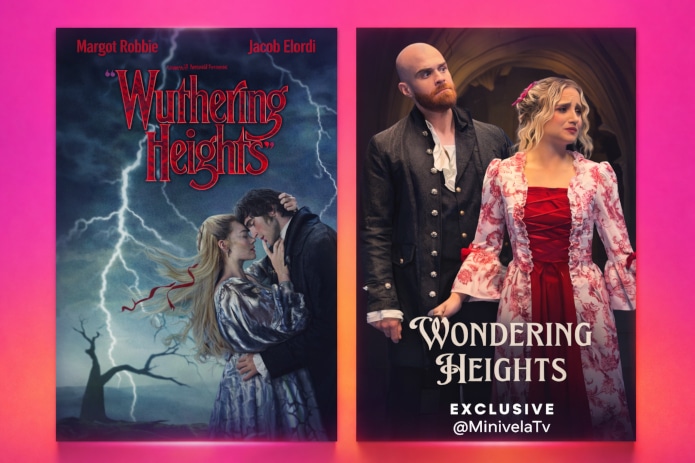
February 12, 2026 — (NOTICIAS NEWSWIRE) — On February 13, Warner Bros Pictures’ Wuthering Heights returns to the big screen, inviting audiences into its stormy romance of longing, heartbreak, and obsession — starring Margot Robbie and Jacob Elordi. But long before it became a gothic classic, Emily Brontë’s tale helped lay the foundation for something far beyond the English moors: the emotional blueprint of the modern telenovela.
That’s right. Wuthering Heights is not just a toxic love story.
It is melodrama — in its purest form.
And in many ways, it is the ancestor of a genre Latin America would one day perfect… and evolve into today’s addictive micro dramas, like this Minivela that is increasingly being binged on social media by a new generation.
A gothic romance that was never subtle
Published in 1847, Wuthering Heights introduced readers to Catherine Earnshaw and Heathcliff, two lovers bound together by a passion so fierce it becomes destructive. Their relationship defies class, family expectations, and even morality. Catherine is pulled between the wildness of her soul and the respectability society demands.
Heathcliff, the outsider, carries the wounds of rejection until love transforms into vengeance.
This is not polite romance.
It’s obsession, betrayal, jealousy, and generational heartbreak.
In other words: this is the telenovela before the telenovela existed.
From gothic novel to radio novela
Of course, the telenovela didn’t appear overnight.
Its modern origins date back to the early 1940s, with the emergence of Spanish-language radio novelas in Argentina, Mexico, and Cuba. Sponsored by consumer goods companies, these dramas — and occasional comedies — brought families together, especially housewives gathered around giant radio sets, listening as love stories unfolded in episodes.
When television arrived in Latin America in the 1950s, the radio novela transformed almost instantly into the telenovela. Brazil took the initiative with Sua Vida Me Pertence in 1951. Cuba followed in 1957 with Hasta Que la Muerte Nos Separe. Mexico joined soon after in 1958 with Senda.
Many of these early works are lost to history, because they were broadcast live, not recorded.
But the genre was only beginning.
The plot, as they say, was about to thicken.
Enter Delia Fiallo, the Queen of the Telenovela
In 1971, Cuban exile writer Delia Fiallo energized the genre forever with a masterpiece called Esmeralda — a Cinderella-like story of a beautiful blind orphaned girl.
It became the model for today’s modern telenovela.
More importantly, it was such a sensation that it became one of the first novelas to be recorded, distributed, and sold throughout Latin America, turning melodrama into an international machine.
From the 1970s through her retirement in the mid-1980s, Fiallo created stories so quickly that she sometimes dictated entire scenes over the phone the very same day they were shot.
She did not shy away from taboo topics: divorce, rape, drug addiction, classism.
And that raw honesty made her characters relatable across every social class.
Some say her work almost single-handedly helped launch the network powerhouses we know today: Televisa-Univision, Telemundo, and beyond.
The legacy still lives
The conquest of international markets continued with classics like Cristal (1985) and Kassandra, which was translated into 22 languages and aired in more than 150 countries — including Japan.
Today, largely on the back of Delia’s more than 43 melodramas, the telenovela has grown from a multimillion-dollar industry into one that generates billions annually worldwide.
And it all traces back to stories like Wuthering Heights — where love is catastrophe, emotion is destiny, and the past never stops haunting the present.
So this weekend, as Wuthering Heights arrives in theaters on February 13, it may look like a gothic romance from another world.
But listen closely.
Behind Catherine and Heathcliff, you can already hear the echoes of the telenovela.
And this time, that echo is unmistakably nuestro — dramatic, impossible, and eternal.
By A. Ruiz